
Knee pain and joint stiffness can make performing your daily activities difficult and painful. This can include walking and climbing stairs. These symptoms can happen with age-related changes to the joints and other forms of arthritis. Joint symptoms can also happen due to injuries and/or repetitive strain. Symptoms can also include a reduced range of motion in your joints.
n Ayurveda, knee pain and joint stiffness are evaluated based on the individual’s condition, health status and possible imbalance of the doshas. Traditionally, a combination of therapies including Abhyanga, Janu Basti and Swedana along with selected herbal formulations may be suggested by an Ayurvedic practitioner.
For those looking into Ayurvedic treatment for knee pain in Sharjah, knowing these traditional methods of treatment gives them an opportunity to make an informed decision about joint care.
Understanding Knee Pain and Joint Stiffness
Knee pain is discomfort in or around the knee joint. Joint stiffness is the inability to fully move a joint. These conditions can occur together, and may affect one or both of your knees.
Others factors may include:
Osteoarthritis: This is due to the degeneration and breakdown of joint cartilage.
Age-related changes: Stiffening of joints and a decrease in the range of motion occurs with aging.
Inflammation: Joints become swollen, feel warm to the touch and are stiff, and have a restricted range of motion with any inflammatory condition.
Muscle Weakness: Disuse of a joint leads to atrophy of the muscles. Weak muscles lead to increased loading on the joints.
Injury: Ligament and cartilage injuries cause knee pain.
Decreased mobility: Prolonged inactivity causes joint stiffness.
What Are the Traditional Ayurvedic Treatments for Knee Pain?
Ayurveda has several external therapies, along with other supportive practices and remedies, for joint discomfort. The selection of treatment is based on the individual’s condition and constitution, and the practitioner’s discretion.
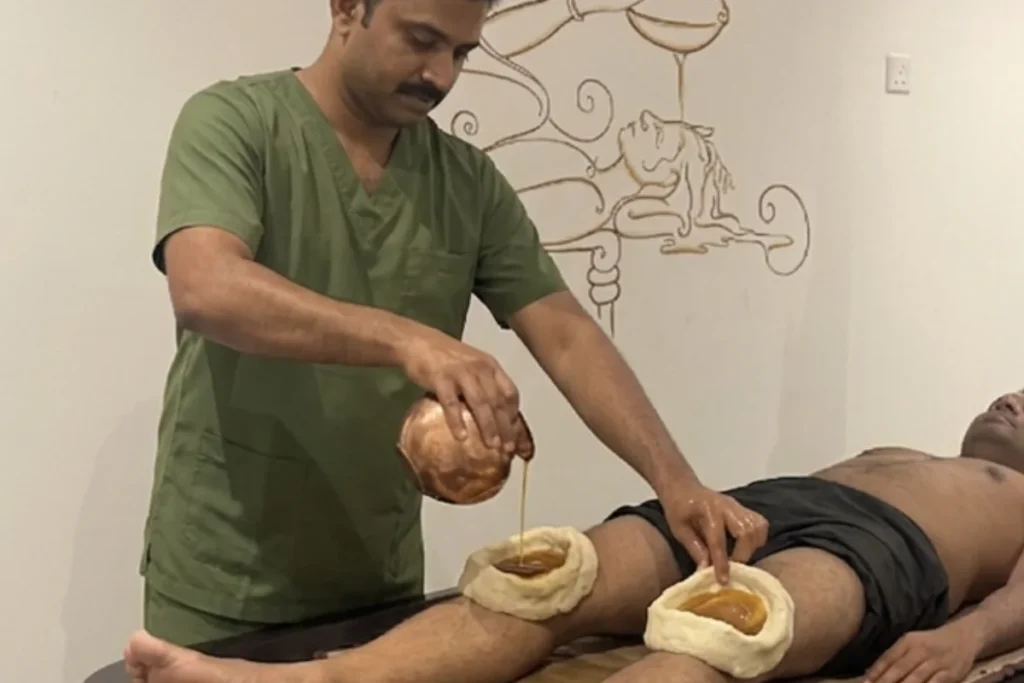
1. Janu Basti: Traditional Ayurvedic Knee Therapy
This is an external Ayurvedic therapy for knee pain and stiffness.
During this treatment, a ring-shaped barrier made from dough is placed around the knee. The ring is then sealed and warm medicated oil is poured into it and allowed to sit for some time, under the supervision of an Ayurvedic therapist.
Janu Basti is traditionally used for:
- Relieving knee joint discomfort and stiffness.
- Providing localized heat to the knee joint.
- Strengthening knee joint ligaments, cartilage and menisci.
- Reducing the progress of knee degeneration.
It may also be used to complement a larger traditional Ayurvedic program for joint comfort.
Janu Basti is individualized based on the discretion of the Ayurvedic practitioner.
2. Abhyanga – Ayurvedic Massage
Abhyanga is a traditional Ayurvedic massage using warm herbal oils. It is included in many of the Ayurvedic wellness programs to provide relaxation and relief from discomfort and stiffness in the musculoskeletal system.
Knee stiffness is relieved by an oil massage around the knee, based on the discretion of the Ayurvedic practitioner, based on the individual’s condition.
Uses of Abhyanga include:
- Relaxing surrounding muscles
- Increasing comfort in the treated area
- Promoting flexibility and mobility
- Aiding relaxation and general well-being
You must choose the oil according to your needs. Massage is not recommended for an acutely inflamed or injured knee without medical assessment.
3. Swedana – Ayurvedic Herbal Steam Therapy
Swedana is a traditional Ayurvedic therapy that uses heat or steam on the body. Depending on the approach, herbs can be incorporated as Churna Pinda Sweda, Pathra Potali Sweda, Jambeera Pinda Sweda, Shashtika pinda Sweda, Upanaha etc.
In Ayurvedic practice, Swedana is done with other therapies to address stiffness and provide relaxation.
Traditionally this therapy has been used for:
- Reducing muscular tightness and inflammation
- Relaxing joints
- Aiding comfort for people with stiffness
- Complementing Ayurvedic massages
4. Upanaha
Upanaha is a type of swedana in which suitable herbal paste is applied on the joint, covered with herbal leaves, then bandaged. It should be kept there for the prescribed time.
Upanaha is used for
- Reducing swelling and inflammation
- Giving support to the knee
- Reducing pain and discomfort
- Strengthening knee joint
5. Patra Pinda Sweda – Herbal Leaf Bolus Therapy
This is an Ayurvedic therapy that uses medicated herbal leaf boluses. This therapy is traditionally used to alleviate muscular and joint discomfort.
Its traditional uses include:
- Relaxing joints
- Providing localized warmth
- Alleviating stiffness and inflammation.
- Supporting other Ayurvedic therapies to relieve muscular discomfort
5. Pizhichil – Therapeutic Oil Application
Pizhichil involves the rhythmic pouring of warm medicated oils over the body.
It is generally offered in combination with other Ayurvedic therapies and interventions and is not recommended for use as the sole treatment for all knee problems.
An Ayurvedic practitioner may recommend this treatment to a client based on the consideration for relaxation and wellness of the client.
6. Basti Therapy – Traditional Ayurvedic Treatment
Basti is one of the important therapeutic and purgation categories of Panchakarma.
There are several classical descriptions of Basti and its variations. This treatment is traditionally related to Vata disorder conditions and selective joint and musculoskeletal problems.
Basti requires professional supervision and an individual assessment. It is not to be performed as a regular home treatment and has to be considered on an individual basis keeping the person’s overall health and condition in mind.
What Are Traditional Ayurvedic Oils For Joint Stiffness?
Different medicated oils may be considered by an Ayurvedic physician depending upon the symptoms and requirements of an individual.
Some traditional oils are:
Mahanarayan Tailam: Traditionally used in various massage therapies for joints and muscular discomforts.
Dhanwantharam Thailam: Traditionally used in various massage therapies and wellness treatments.
Kottamchukkadi Thailam: Traditionally used in a wide range of topical applications in musculoskeletal conditions.
Sahacharadi Thailam: Used in numerous massage therapies for joints, muscular conditions, etc.
The oils are typically individualized based on patient condition, and cannot be interchanged. Traditional usage does not support their efficacy in cartilage repair or reversing osteoarthritis or joint disease.
How Does Ayurveda Approach Osteoarthritis and Age-related Knee Pain?
Osteoarthritis is a common reason for knee pain, especially with the elderly population. It occurs due to deterioration of the cartilage and underlying bone, and also affects the supporting structures of the joints.
In Ayurveda, a number of conditions such as pain, stiffness and restriction in joint movement may fall under a concept of Sandhivata.
Sandhivata may be caused by Vataja imbalance in the joints and traditional Ayurvedic approach may be to advise one or a combination of the following:
· Prescribed external therapies.
· Swedana (sweat induction) therapies.
· Ayurvedic preparations, diet, lifestyle modifications and practitioner advised joint and muscle activities.
In modern medicine, osteoarthritis of the knee may be managed by a number of interventions like weight reduction, pain management, etc. based on the assessment of the clinical situation.
Ayurvedic therapies and practices may act as supportive and additional therapies for osteoarthritis of the knee. In early stages it can cure the condition and later stages can manage the pain and reduce the progress of the disease.
Ayurvedic Lifestyle and Dietary Practices for Joint Health
As per the principles of Ayurveda, yoga and simple daily exercises with lifestyle and diet modifications can be complimentary measures for joint health.
1. Stay Active
Walking and stretching are low-impact exercises that help with joint function. People can walk or stretch, within comfort level, to prevent loss of joint function. Pain plays a role in if and what kinds of exercises are allowed. For high levels of pain and unmanageability, strengthening exercises may not be done.
2. Eat Well
There are many foods that are beneficial for joints. However, a diet rich in vegetables, fruits, legumes, whole grains and nuts, seeds, and oils along with regular physical activity promotes joint health.
3. Weight Management
Being obese or overweight worsens knee symptoms because it increases the load on knee joints. It is recommended to manage weight to reduce the load on the knees.
4. Avoid Inactivity
Joint inactivity causes stiffness. It is recommended to avoid prolonged inactivity by moving for a short period of time every hour, or by engaging in exercises that promote joint function.
5. Professional Guidance
Ayurvedic dietary changes should be individualized. Likewise, herbal preparations should also be given depending on the individual. Herbal preparations should be taken with caution if one is on regular allopathic medications.
When Should You Go See a Doctor for Knee Pain?
Just an oil massage is not recommended for any knee pain.
You should go see a doctor if you have:
- Severe or sudden pain
- Swelling with or without redness
- Fever with knee pain
- Inability to bear weight or put any load on the knee
- Deformity of the knee after injury
- Knee pain with inability to move knee joints
- Pain that prevents you from doing your daily activities
Where to Find Ayurvedic Treatment for Knee Pain in Sharjah?
Patients in Sharjah who want to get traditional Ayurvedic treatments for knee pain and joint stiffness can check out professional Ayurvedic services at Herbal House Ayurveda Sharjah.
A thorough evaluation of a patient’s symptoms and health is necessary to determine an appropriate treatment plan. Based on the assessment, a qualified practitioner can advise traditional therapies and other Ayurvedic methods.
Herbal House Ayurveda is built on the values of traditional Ayurvedic practices and personalized wellness. Anyone who experiences worsening or persistent knee pain should seek appropriate evaluation to understand the cause.
Choosing a qualified practitioner and following a personalized treatment plan are vital steps when beginning your journey with Ayurveda for joint care.
Conclusion
There are a variety of Ayurvedic methods for people experiencing stiffness and pain in the knees. Janu Basti, Abhyanga, Swedana, Patra Pinda Sweda, Upanaha and other selective Basti treatments are part of different Ayurvedic treatment programs.
For those interested in traditional Ayurvedic treatment in Sharjah, Herbal House Ayurveda allows you to become more familiarized with personalized treatment options while also focusing on your joint health and care.